Pat Fitzgerald
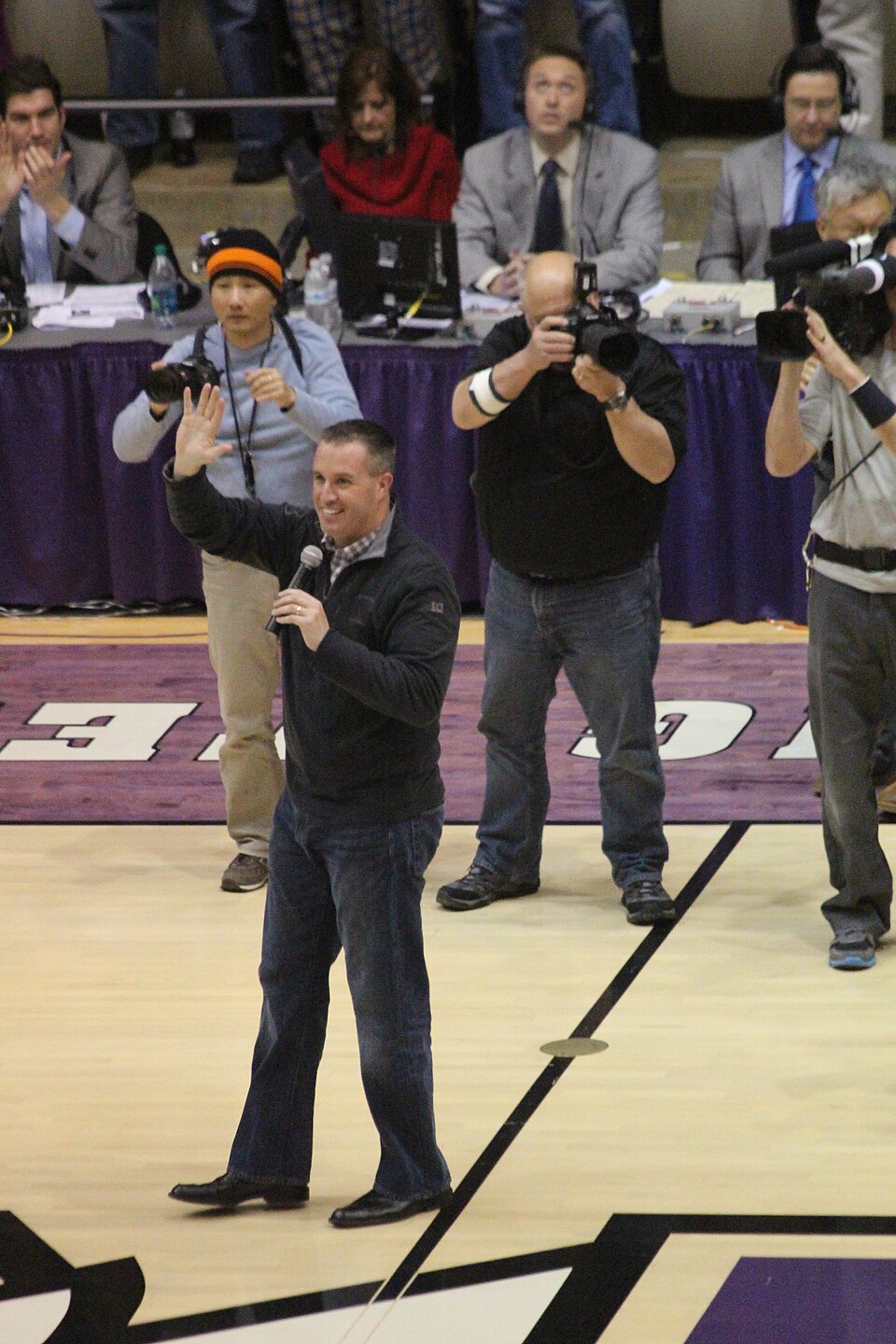
Introduction
Pat Fitzgerald, the winningest head football coach in Northwestern history, was fired on July 10, 2023, after an independent investigation found widespread hazing in the program — including forced nudity and sexualized acts — that university president Michael Schill said Fitzgerald failed to know about and prevent. Schill announced the dismissal days after initially suspending Fitzgerald for two weeks, ending a 17-year tenure in one of the biggest coaching scandals of the 2023 offseason.
Background Information
Patrick William Fitzgerald Jr., born December 2, 1974, in Midlothian, Illinois, starred as a linebacker at Northwestern from 1993 to 1996, helping lead the Wildcats to a 10–1 regular season in 1995 and a Rose Bowl berth and winning the Bronko Nagurski Trophy and Chuck Bednarik Award twice each. Inducted into the College Football Hall of Fame in 2008, he went undrafted in 1997 and, after a brief stint with the Dallas Cowboys, began coaching at Maryland in 1998, returning to Northwestern in 2001 as its linebackers coach and recruiting coordinator.
Fitzgerald was promoted to head coach in 2006 following the sudden death of Randy Walker, becoming, at 31, the youngest head coach in the Big Ten and NCAA Division I FBS. He became the longest-tenured head coach in Northwestern history, compiling a 110–101 record over 17 seasons with Big Ten West Division titles in 2018 and 2020. His final season ended 1–11, the program’s lowest win total since 1989.
The Controversy or Incident That Led to Their Cancellation
The scandal grew out of a November 2022 complaint by a Northwestern player that prompted an independent investigation by law firm ArentFox Schiff. Investigator Maggie Hickey, a former Illinois inspector general, said the players’ accusations were “largely supported by evidence.” The accuser described being dry-humped by upperclassmen, forced through lines of spinning naked teammates in showers, and compelled to snap a football while naked, saying: “Everyone would just be looking at each other and be like ‘bro, Fitz knows about this,’ because you wouldn’t take that action otherwise.”
An anonymous former player, in a report published by The Daily Northwestern, accused Fitzgerald of presiding over and taking part in a hazing ritual dubbed “running,” in which upperclassmen would pin down a younger player and mount him inappropriately. “It’s done under this smoke and mirror of, ‘Oh, this is team bonding,’ but no, this is sexual abuse,” the player alleged. The university’s summary of the probe’s findings said the hazing included “forced participation, nudity and sexualized acts of a degrading nature, in clear violation of Northwestern policies and values.”
On July 7, 2023, Fitzgerald was suspended for two weeks without pay. The investigation summary said “participation in or knowledge of the hazing activities was widespread across football players,” though investigators found no “sufficient evidence” that the coaching staff knew about it — only significant opportunities to discover and report it. After The Daily Northwestern reported new details, Schill said he “may have erred in weighing the appropriate sanction,” and on July 10 he fired Fitzgerald, citing “his failure to know and prevent significant hazing in the football program.” Schill said 11 current or former players acknowledged hazing had been ongoing, with more confirming it was “systemic dating back many years.” He noted the investigator “failed to find any credible evidence that coach Fitzgerald himself knew about” it, but wrote: “The head coach is ultimately responsible for the culture of his team… The hazing we investigated was widespread and clearly not a secret within the program, providing coach Fitzgerald with the opportunity to learn what was happening.”
Fitzgerald denied any knowledge of the hazing, saying he and Schill had reached a “mutual agreement regarding the appropriate resolution” that was “unilaterally revoked our agreement without any prior notification,” insisting he had “no knowledge whatsoever of any form of hazing within the Northwestern football program.” He retained attorney Dan Webb of Winston & Strawn LLP to take “the necessary steps to protect my rights in accordance with the law.”
Public Reaction and Consequences
The firing drew national attention and broad public support for the coach. Schill said he received “hundreds and hundreds of emails describing how [Mr Fitzgerald] has transformed the lives of current and former student athletes,” but insisted the university had “an obligation — in fact a responsibility — to live by our values, even when it means making difficult and painful decisions such as this one.” Multiple former athletes also came forward to corroborate that hazing occurred, some alleging racism.
Northwestern named defensive coordinator David Braun the interim head coach for the 2023 season. Fitzgerald, who said he was “surprised” by the termination, retained legal counsel, while Schill maintained that “the decision to originally suspend coach Fitzgerald was mine and mine alone, as is the decision to part ways with him.” The case became a national flashpoint in debates over hazing: the university’s own investigation found no “sufficient evidence” that the coaching staff knew about the hazing even as it concluded the activities were widespread.
Current Status
As of late August 2026, Fitzgerald has returned to the top of college football. After his dismissal he was a volunteer assistant at Illinois’ Loyola Academy from 2023 to 2025, where his son Ryan was the starting quarterback; the school won the 2023 IHSA Class 8A State Championship. On December 1, 2025, Michigan State hired him as head football coach, and he is listed as the current head coach of the Spartans.
Impact on Their Career/Life
The firing ended a coaching tenure built on stability and success, one in which Fitzgerald led the Wildcats to ten bowl games, earning the Hayes–Schembechler (2018) and Bobby Dodd (2020) Coach of the Year awards. Yet within days of his suspension, the university concluded he had “failed to uphold” his commitment to the student experience, permanently attaching his name to one of college football’s most prominent hazing scandals.
Fitzgerald consistently denied knowledge of the hazing, and the university’s investigator found no credible evidence that he knew about it — a nuance that shaped debate over whether the firing was justified or rushed. The case showed how quickly a celebrated career can collapse when an institution decides a coach’s responsibility for team culture outweighs his record. Less than three years later, his return as Michigan State’s head coach proved the cancellation did not end his coaching life; by late August 2026 he was again leading a Big Ten program, the scandal permanently part of his legacy.