August Hanning
Introduction
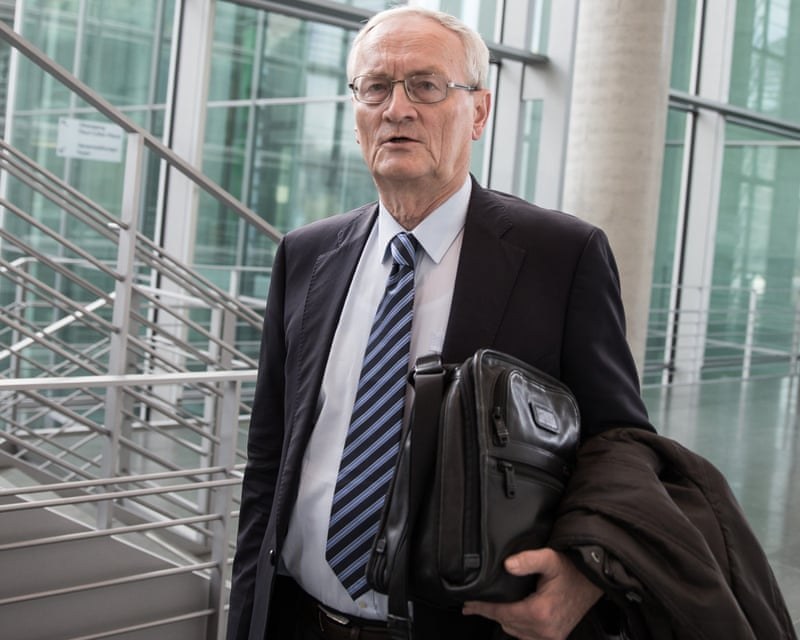
August Hanning, the 80-year-old German retired civil servant who headed Germany’s foreign intelligence service, the Bundesnachrichtendienst (BND), from 1998 to 2005 and later served as State Secretary in the Federal Interior Ministry, was arrested in southern Germany on October 6, 2026, on suspicion of treasonous espionage and spying out state secrets . German federal prosecutors allege that after leaving the BND he received roughly 2,000 classified documents from a former aide in exchange for payment, and that he used the material in private consulting work, including drafting an analysis for an officer of a foreign intelligence service . The case has been described in German media as potentially one of the most serious spy scandals in the history of the Federal Republic . The suspicions are the product of an ongoing prosecution, not a court judgment: no charge has been adjudicated.
Background Information
Hanning was born on February 16, 1946, in Nordwalde and trained as a lawyer, completing a doctorate in environmental protection law in Münster in 1975 . He joined the Federal Ministry of the Interior as a referent in 1977, moved to the Federal Chancellery in 1981, and served from 1986 to 1990 as the security-protection officer at West Germany’s permanent representation in East Berlin, where he was also responsible for the ransom-purchase of political prisoners . After German reunification he became a close aide to the government commissioner for the intelligence services, Bernd Schmidbauer, and was appointed coordinator of the federal intelligence services in 1996 .
On December 17, 1998, he became president of the BND, succeeding Hansjörg Geiger, and led the service until 2005 — a period that included the decision to relocate the BND’s headquarters from Pullach to Berlin . His tenure also brushed against two internationally consequential episodes: in December 2002 he wrote to CIA director George Tenet that the informer known as “Curveball” could not corroborate claims about Iraqi weapons of mass destruction, which the US government nonetheless presented at the UN ahead of the Iraq war; and German media reported that he opposed the return of Guantanamo detainee Murat Kurnaz to Germany . When Angela Merkel became chancellor, Hanning moved on December 1, 2005, to the Interior Ministry as State Secretary with responsibilities including police matters, internal security, migration and crisis management, before retiring from that post on November 10, 2009 . After leaving government he worked as a private consultant in security and business, trading on his former intelligence credentials, and was considered well connected in Russian and Chinese government and business circles .
The Controversy or Incident That Led to Their Cancellation
Allegations. The claims in this section are allegations from the German Federal Prosecutor’s Office (Generalbundesanwalt), which announced the arrests on October 6, 2026. They were never admitted by August Hanning, have not been tested at trial, and are not adjudicated. Hanning has not yet entered a plea in proceedings that had just begun when this page was written.
According to the federal prosecutor’s office, Hanning is “strongly suspected of treasonous espionage, spying out state secrets, attempted treason, and espionage” . Prosecutors allege that he and a former aide, identified only as Manfred D., agreed in 2010 that Manfred D. would continuously transmit valuable intelligence from the BND to Hanning in exchange for payment . Manfred D., who served as Hanning’s bureau chief and later as chief of staff to successive BND presidents from 2012 until 2026, is accused of using that role to access highly confidential information and passing Hanning approximately 2,000 documents over the years, many containing classified material reserved exclusively for internal BND use, including executive intelligence briefings .
Prosecutors allege Hanning used the material in his private consulting work, and that on one occasion he “used classified intelligence provided by Manfred D. to draft an analysis for an officer of a foreign intelligence service” . The prosecutor’s office did not disclose which countries were involved and said it has yet to be determined whether the material reached its intended recipient . Hanning is also accused of having been “in close contact with a representative of another foreign intelligence service, to whom he passed on political information, partially based on material provided by Manfred D., for several years” . Prosecutors believe he intended to resell the documents through the paid consulting practice he built after leaving the BND; the extent of any dissemination remains under investigation .
Hanning was arrested on the morning of October 6, 2026; the federal prosecutor’s statement placed the arrest in the Bad Tölz-Wolfratshausen district, while the Guardian and local media reported he was taken from his home in Nordwalde near Münster, where masked officers were photographed moving him from his redbrick house to a bullet-proof vehicle . Manfred D. was arrested the same day in the Steinfurt area of western Germany and is charged with aiding and abetting attempted treason and treasonous espionage; the BBC, citing local media, reported his arrest location as Bavaria . Several properties connected to both men, including in Berlin, were searched simultaneously .
The case came to light indirectly: investigators examining the alleged abduction of the children of Hamburg steakhouse heiress Christina Block — a custody-dispute kidnapping that Block is separately charged with orchestrating, and which Hanning is alleged to have helped organize, which he denies — searched Hanning’s residence in that connection and discovered an electronic storage device containing sensitive material, including recent BND documents . That discovery triggered the espionage investigation that led to the October 2026 arrests .
Public Reaction and Consequences
The arrest of the man who once ran Germany’s foreign intelligence service drew immediate international coverage, with Yahoo News commentary describing it as potentially the most serious spy scandal in German history . The BND did not immediately respond to a request for comment . Hanning was scheduled to appear before a judge on October 7, 2026, the day after his arrest, while Manfred D. was to appear at the federal court of justice in Karlsruhe on October 6 . Under German procedure, arrests on strong suspicion of treason are a prosecutorial step; the suspects remain presumed innocent unless and until convicted.
The affair adds to a recent run of espionage embarrassments for the BND: in 2023 a high-ranking BND officer, identified as Carsten L., was charged with treason for allegedly passing secrets about the Ukraine war and the Wagner Group to Russia for roughly €400,000; that trial is ongoing .
Current Status
As of October 6, 2026, Hanning remained in custody following his arrest that morning, with an initial judicial appearance scheduled for the following day . The investigation — including the questions of which foreign services were involved and whether any material reached them — remained open . No indictment had been filed at the federal court of justice and no trial date existed. This page will be updated as the proceedings develop.
Impact on Their Career/Life
The arrest ended, at least for the duration of the proceedings, the post-government career on which Hanning had built two decades of consulting work: after leaving the BND he marketed himself globally on his intelligence credentials and cultivated ties in Russian and Chinese government and business circles, and it is precisely that private consulting practice in which prosecutors say he intended to resell the classified material he allegedly received . For the BND, the image damage is acute — its former president accused of the crimes most antithetical to the service’s mission, arriving months after the separate Carsten L. treason case — and German commentary has begun framing the affair as one of the gravest spy scandals in the country’s postwar history . If the allegations are proven at trial, Hanning would face sentencing for treason and espionage offenses carrying multi-year to life-scale penalties under the German criminal code; if they are not, his record will show an 80-year-old public servant arrested and detained on suspicion later held insufficient.
Sources
- BBC News, “Former German spy chief arrested for espionage and treason,” October 6, 2026 — source
- The Guardian, “Germany arrests former intelligence chief over alleged spying,” October 6, 2026 — source
- New York Post, “Ex-spy chief August Hanning is arrested in Germany on suspicion of trading state secrets and treason,” October 6, 2026 — source
- Yahoo News/AFP, “Germany’s former spy chief arrested for treason,” October 6, 2026 — source
- German Wikipedia, “August Hanning,” accessed October 6, 2026 — source