Kate Polak
Introduction
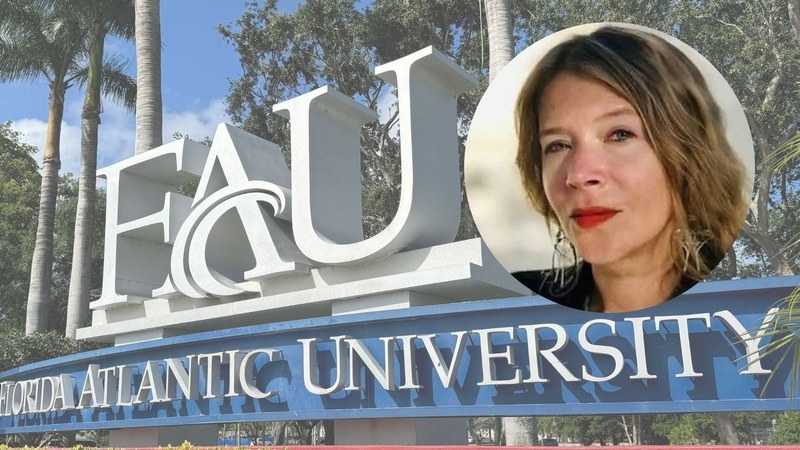
Kate Polak is a full-time English instructor in Florida Atlantic University’s College of Arts and Letters who was placed on paid administrative leave in September 2025 over personal social-media posts about Charlie Kirk, then dropped by the university four months later even though the outside investigator it hired had concluded that discipline was not warranted. She was one of three FAU faculty members investigated after Kirk’s September 10, 2025 assassination — alongside art history professor Karen Leader and finance professor Rebel Cole, whose cases are covered in their own entries here — and the only one of the three not reinstated. In January 2026, FAU declined to renew her yearly contract despite an investigative report finding discipline “does not appear warranted” under the university’s own rules, an outcome she called political and said she would fight in court.
Background Information
Polak joined FAU in 2020 as a visiting instructor and was employed on a yearly contract rather than the tenure track, the more precarious category that distinguished her case from the two tenure-line colleagues investigated alongside her. Her record was clean: no prior discipline in five years, personnel records showing “effective teaching and performance,” and — per Faculty Senate president Bill Trapani — some of the highest student evaluations at FAU. Her Facebook account was private, and she said she did not believe anyone outside her friends or their friends would see her comments there.
Kirk, the conservative Turning Point USA founder, was fatally shot on September 10, 2025, at Utah Valley University, and FAU responded to the fallout by placing Leader, Cole, and Polak on paid administrative leave and hiring Alan Lawson, a former conservative justice of the Florida Supreme Court, as outside counsel to investigate all three.
The Controversy or Incident That Led to Their Cancellation
Allegations. The claims in this section are allegations from an outside investigation conducted for Florida Atlantic University by former Florida Supreme Court justice Alan Lawson, which characterized Polak’s posts one way. They were never admitted by Polak, never criminally charged, and never adjudicated in court. Polak denies the characterization and says she was not condoning gun violence, that her posts were made off the clock on her personal accounts, and that her record shows no harm to the university.
The investigation began after FAU received three email complaints with screenshots of Polak’s posts on Facebook and Threads, including posts not about Kirk. She was placed on paid leave in September 2025; she told FAU’s student-run University Press the notice came by email after she replied to other users on Threads about Kirk, including one comment quoted in coverage: “Delighting in the death of someone who wished death on us isn’t sick. It’s self-defense.”
Lawson’s report concluded that three posts, all Kirk-related, would “warrant consideration for discipline,” posts he said “celebrated” his assassination on a college campus: Polak said in a Facebook comment she could share video of the “exact moment” Kirk was shot, adding “lol”; wrote that seeing him shot was a “win” she “enjoyed”; and posted the Threads comment above. The report said her posts were viewable beyond her immediate network but not widely viewed, drawing only the three email complaints. It also swept in unrelated material — posts criticizing police presence at an anti-ICE protest on campus and comments about her job — while Lawson wrote that her performance and students were not affected by her posts. Polak told investigators she posted off the clock, was not speaking for FAU, and was not condoning gun violence.
Public Reaction and Consequences
The suspensions drew faculty criticism over free speech, a joint Faculty Senate–union resolution in October 2025, and a federal First Amendment lawsuit from Cole; on November 18, 2025, Leader and Cole resumed full duties with no discipline after Lawson found their speech constitutionally protected — but Polak’s investigation continued with no explanation, and she remained barred from campus into January. “It’s humiliating,” she told the South Florida Sun Sentinel, in remarks published by CBS12, noting she was scheduled to teach two spring classes. Former students sent support during the investigation.
In mid-January 2026, a letter from English department chair Oliver Buckton informed Polak “as a professional courtesy” that Lawson’s investigation had concluded and FAU would not renew her appointment; her paid leave ended that day, too late to teach a semester that had started eleven days earlier. The report found her posts “would be understood by most readers as condoning on-campus violence” and that discipline “would be constitutionally permissible based upon their potential for harming the University’s mission,” but held that discipline “does not appear warranted”: under university regulations and the collective-bargaining agreement, discipline for off-the-job conduct requires demonstrated actual harm to the university’s mission, “which has not been demonstrated on the record reviewed.” The university proceeded anyway; spokesperson Joshua Glanzer declined to explain why, saying FAU does not comment on personnel matters, while confirming it had accepted Lawson’s findings. Trapani called the “hasty and subjective” non-renewal, announced “within mere hours” of a report recommending no such discipline, a due-process problem inconsistent with Cole’s treatment.
Current Status
Polak’s FAU employment ended with the non-renewal, effective with the spring 2026 semester she was never allowed to teach. She learned the investigation had concluded only when the Sun Sentinel contacted her, and said the university appeared to be trying to “evade disciplinary action by not renewing my contract.” “This entire process has been political theater, aimed at first, making me afraid, and second, aimed at making all the other instructors in the university afraid.”
Impact on Their Career/Life
The non-renewal severed a five-year FAU career that the university’s own investigative record described as effective teaching with no prior discipline. Polak said she was chosen as a “scapegoat” for her political views, the yearly-contract instructor being the easiest of the three to remove — a reading echoed by Trapani’s point that her outcome diverged from the tenure-line pair’s. “Yeah, I did indeed say some really mean things,” she said, “but I don’t believe mean things off-hours deserve this,” adding that “the way I’m being characterized is based on one rude night in a lifetime of kindness.” She framed the case as an effort to chill FAU faculty speech: “I’m merely an avatar for what they’re actually going after.” Unlike Cole, whose suit was already pending, she had not filed a lawsuit as of the January 2026 reporting.