Eugene Horsch
Introduction
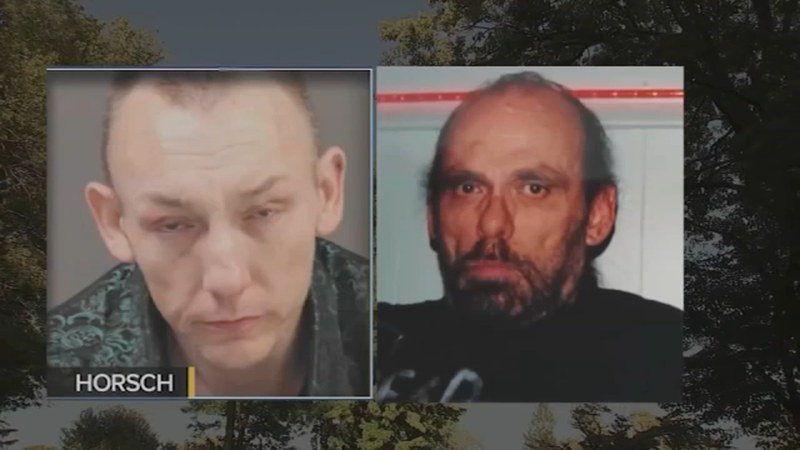
Eugene Horsch is a 44-year-old Philadelphia man who has been held in federal custody since June 2026, when a parking stop near Independence Mall put guns, drugs and fake law-enforcement credentials in view of park police — and put investigators onto his family’s Olney rowhouse. The search of the West Chew Avenue home recovered more than a million digital images and tens of thousands of videos, and it has been linked to seven missing or unidentified women, some of whom appear in the files unconscious or lifeless. Horsch has been indicted only on firearms and fake-identification charges; he has not been charged in connection with any of the women, and no bodies have been found.
Background Information
The Chew Avenue property belonged to Horsch’s father, Raymond “R.C.” Horsch, an erotic filmmaker and photographer who wrote a book titled “Memoir of an Empathetic Serial Killer” and, per the Philadelphia Inquirer, recruited women experiencing addiction with offers of money and drugs in exchange for appearing in his films. The elder Horsch had a criminal history spanning counterfeiting, drug manufacturing, fraudulent identities and firearms, tried to abduct a 9-year-old girl in 2009, and owned the house until he transferred it to Eugene in 2006. He died in 2025 at age 82, months after a fire prompted a narcotics search that turned up marijuana plants, guns and chemical containers. Friends and relatives of missing women had reportedly pointed authorities to the property in years past, without an investigation following.
The Controversy or Incident That Led to Their Cancellation
Allegations. The claims in this section are allegations from Philadelphia police, court filings and news investigations, which report that evidence from the Chew Avenue house is linked to seven missing women. Eugene Horsch has never been charged in connection with any woman’s disappearance or death, nothing about the women has been adjudicated, and no remains have been recovered. He stands charged only with firearms and fake-credential offenses, has not entered a plea, and his attorney has said he plans to plead not guilty; police themselves caution that some recovered videos may be staged adult-film material rather than real violence.
The case began on June 19, 2026, when a U.S. Park Police officer approached a black BMW parked where it did not belong on the 600 block of Market Street around 8 p.m. Inside were Horsch and a woman. According to a criminal complaint, the car held guns, drugs, weapons and a fake DEA identification bearing Horsch’s photo — an agency he never worked for. The woman’s own ID displayed her photograph over the name of Blair Tonzelli, a 35-year-old reported missing in 2023, and she allegedly told police Horsch gave it to her. Horsch was arrested that night on weapons and narcotics charges. A federal indictment followed in early July: a convicted felon in possession of firearms, including one with an obliterated serial number, plus possession of fake DEA and FBI credentials and unlawfully producing an identification document.
The traffic stop led investigators to the 400 block of West Chew Avenue, where police and the FBI recovered more than 600,000 images, 70,000 videos and over 10,000 pages of writing across computers, hard drives, cameras and phones — with only about 30 percent reviewed as of mid-September. The home also held a “homemade laboratory” with chemicals now at a federal lab in Chicago, a 55-gallon drum plumbed into water lines, five urns of cremated remains, guns, ammunition and a small marijuana-growing operation; investigators have excavated parts of the property under nearly 100 search warrants. Seven women have been connected to the case: Tonzelli; Amy McHale, 44, Horsch’s father’s ex-wife, missing since 2016 and last seen at the house per her family; Gabrielle Amarando, 22 when she vanished in 2012; Maribel Fresses, 27, missing since 2018; Nicole Fusaro, 27, missing from Kensington since 2018; a 25-year-old whose family asked that she not be named; and one woman not yet identified. Police say five women appear lifeless in the recovered material: images drawn from a 2017 hard drive show Amarando and Fresses alive and later apparently dead, and a video shows R.C. Horsch placing a zip tie around a woman’s neck until she lost consciousness — a woman police identified as Fusaro. Deputy Commissioner Frank Vanore urged caution: “some of this is play acting, and some of it we believe could be real.” Fifty-eight people have been identified in the images; witnesses have largely refused to cooperate. In late September, a woman who said she met father and son in Camden in 2012 while homeless recalled blacking out at the house and waking to R.C. photographing her, and said Eugene threatened to kill her weeks later; she told WPVI her own image is among the recovered files.
Public Reaction and Consequences
The investigation has unsettled the Olney neighborhood, where residents described decades of quiet broken by excavators and federal agents. The families of the missing women have become the case’s public voice. Jonathan Halloran-Koren, Fusaro’s cousin, said he was “appalled by the way our family has been treated and by the complete lack of basic dignity and consideration shown to us as the family of a homicide victim,” launched a petition calling for expanded FBI assistance, and said his goal is to “find every woman.” Amarando’s childhood friend remembered her as “a wonderful soul” whose struggles with addiction did not define her.
Current Status
As of late September 2026, Eugene Horsch remains in federal custody on the firearms and fake-credential charges, with a court hearing set for November 3; court records show no plea entered, and his attorney, Jerry Brown, has said he plans to plead not guilty. He has not been charged in connection with the disappearance or death of any woman. The FBI has increased the agents assigned to authenticate the digital trove, and Philadelphia police planned another search of the property at the end of September. R.C. Horsch died before the investigation began, leaving investigators to untangle which material — if any — documents real violence.
Impact on Their Career/Life
Whatever the investigation ultimately establishes, the case has already made Horsch’s name synonymous with one of the most disturbing inquiries in Philadelphia’s recent history. It has become a case study in the forensics of absence: with no bodies, no DNA and no remains, investigators must build identifications from a mountain of digital files, a challenge former FBI agent J.J. Klaver called “really challenging” for want of any easy DNA source to match. For the families of seven women, the review’s slow pace is itself the controversy, and the house on Chew Avenue remains an active scene.
Sources
- *NY Post (X post), “Woman recalls chilling encounter with vile pornographer, son inside Philly house of horrors linked to 7 missing women,” September 28, 2026 — source
- *NY Post, “Woman recalls chilling encounter with vile pornographer, son inside Philly house of horrors linked to 7 missing women,” September 27, 2026 — source
- *CNN, “Eugene Horsch: Five women feared dead in connection to Philadelphia home where disturbing images were recovered,” September 17, 2026 — source
- *FOX 29, “Horsch investigation timeline: Everything we know about missing women case,” September 2026 — source
- *WPVI/6abc, “What we know about 7 women linked to investigation at home in Philadelphia’s Olney neighborhood,” September 2026 — source
- *USA Today, “Fifth missing woman linked to Eugene Horsch’s home in Philadelphia,” September 16, 2026 — source
- *Billy Penn, “Philadelphia’s ‘house of horrors’ investigation: All that we know,” September 18, 2026 — source