Saul Vargas
Introduction
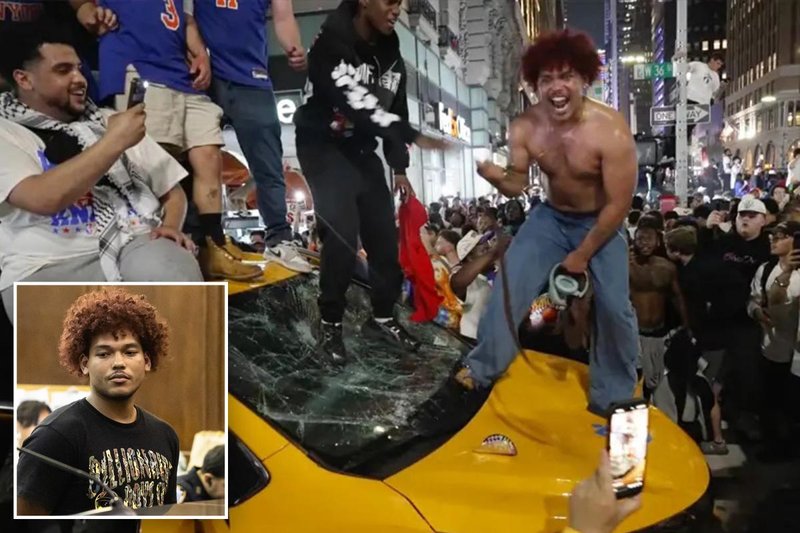
Saul Vargas — a 21-year-old from St. Cloud, Florida — became the most recognizable face of the June 2026 Knicks championship riot in Manhattan after he was caught on video climbing onto a yellow taxi and smashing its windshield amid the street celebrations that followed the Knicks’ historic Game 4 comeback in the NBA Finals. He was charged with criminal mischief after turning himself in days later, and in September 2026 he resolved the case by taking a plea deal on a disorderly conduct violation with $500 in restitution to the driver. After emerging from the Manhattan courtroom, he justified the destruction as birthday fun — “I was being a kid, I was being stupid” — while offering an apology to the driver he helped put in the hospital.
Background Information
Before June 2026, Vargas was an ordinary 21-year-old from St. Cloud, Florida, a city in the Orlando metro area, with no public profile beyond his social-media presence. That changed on the night of June 11, 2026, when the New York Knicks erased a record 29-point deficit against the San Antonio Spurs in Game 4 of the NBA Finals — OG Anunoby’s tip-in with 1.2 seconds left sealing a 107-106 win and a 3-1 series lead — and thousands of fans flooded the streets around Madison Square Garden. In the chaos, a taxi driven by 59-year-old Noueddine Bitat, an Algerian immigrant ending a 13-hour shift, became trapped in the mob at 36th Street and Seventh Avenue around 12:30 a.m. Videos of fans shattering the cab’s windshield and jumping on its hood went viral, and the NYPD said it made 56 arrests that night — 41 people released with summonses, 15 criminally charged. Vargas, shirtless on the roof of the cab, became one of the only alleged offenders police publicly named.
The Controversy or Incident That Led to Their Cancellation
Allegations. The conduct described in this section was alleged in a criminal complaint and widely documented on video, but Vargas was never convicted of a crime: he resolved the case through a plea to disorderly conduct, a violation that carries no criminal record. The facts below come from police statements and news reports, and Vargas has acknowledged being on the taxi while disputing how his actions have been characterized.
According to the NYPD, Vargas was one of three men sought for attacking Bitat’s parked cab at 36th Street and Seventh Avenue in the early hours of June 11, about an hour after the Knicks’ win. Viral video showed vandals shattering the windshield and jumping on the hood, and police said Vargas — while not among those seen in the widely viewed clip itself — was accused of repeatedly whipping the cab’s hood with a belt and denting it; the group also tried to flip the taxi over. The mob pulled Bitat from the vehicle, grabbing him by the neck and punching him in the head, though no report identifies Vargas as participating in the assault on the driver. Bitat suffered a diabetic attack after the beatdown and later said he felt “lucky to be alive,” telling reporters he did not plan to return to chauffeur work. After the video spread, police sought Vargas on a criminal mischief charge; he turned himself in at the Midtown South precinct on the evening of Monday, June 15, and was arraigned the next day in Manhattan Criminal Court.
Public Reaction and Consequences
The public response played out in two waves. In June, the viral clip made Vargas the target of a police search — officers publicly named him, unusual for a case in which most of the 56 people taken into custody that night went unnamed — and the taxi driver’s plight drew sympathy and fundraising: the New York Taxi Workers Alliance partnered with rapper French Montana and TikTok star Zachery Dereniowski to raise money for Bitat. In September, Vargas took a plea deal in Manhattan Criminal Court, pleading to disorderly conduct — a non-criminal violation — and was ordered to pay $500 in restitution to the driver; he has a virtual compliance hearing scheduled for November 25, 2026. Exiting the courtroom in a red T-shirt and headphones, he told the Daily Mail, “I just want to be 21,” then defended the episode as celebration: “At the end of the day, I’m 21. I was being a kid, I was being stupid… It was my birthday, I was trying to have fun but that’s not a good excuse.” The comments — paired with his apology, “To the taxi driver, I do apologize. It’s something no driver should have to go through” — drew fresh waves of criticism online, with commenters seizing on the notion that a birthday justified destroying a stranger’s livelihood.
Current Status
As of mid-September 2026, Vargas’s case is resolved to a plea but not fully closed: the disorderly conduct plea and $500 restitution stand, and his virtual compliance hearing is set for November 25, 2026. Because disorderly conduct is a violation rather than a crime in New York, the plea leaves him without a criminal conviction. The wider investigation continues: NYPD officials said after Vargas’s arrest that they were still looking for other suspects in connection with the cab attack. Bitat, the driver, said through a translator that he could not believe a job like driving a cab could be so risky and was not planning to return to the gig.
Impact on Their Career/Life
Vargas’s life changed in a way that outlasts the legal outcome: he arrived in New York as an anonymous fan and left as the named villain of a citywide riot, his shirtless rooftop moment preserved in news archives worldwide. The legal cost was modest — a violation-level plea and $500 in restitution — but the reputational one is not: his name is permanently attached to the assault on Bitat, whose injuries and lost livelihood became the story’s moral center. His own words did the most damage. By framing the destruction as birthday fun — “I was being a kid” — while weeping “I just want to be 21,” Vargas turned a routine plea into a fresh viral moment, prompting the kind of public scorn that outlives court dates. Whether he can move past the episode — the November compliance hearing is his last scheduled court date — the episode stands as a case study in how a single night of celebration, and the refusal to show remorse afterward, can define a person’s public identity.