Lindsay Clancy
Introduction
Lindsay Clancy is a former labor and delivery nurse from Duxbury, Massachusetts, whose murder trial ended not in a verdict but in a mistrial. Clancy, 36, was charged with strangling her three young children, Cora, 5, Dawson, 3, and Callan, 8 months, on January 24, 2023, and admitted the killings while claiming severe postpartum psychosis made her not criminally responsible. After five weeks of testimony and 38 hours of deliberations, a single holdout juror left the jury deadlocked 11 to 1, and on September 4, 2026, Judge William Sullivan declared a mistrial. In the days since, her lawyer has revealed she is on round-the-clock suicide watch and has asked the judge to find her not guilty by reason of insanity, while a supporters’ GoFundMe for her parents passed $1.1 million, while prosecutors decide whether to retry her — a decision that moved closer on October 1, when the judge denied her defense’s bid for a required finding of not guilty. She remains in state custody at Tewksbury Hospital.
The case took a fresh turn on September 28, 2026, when the lone holdout juror was publicly identified as Michael P. Desronvil, whose attorney said his client “had zero doubt” about holding out for a conviction.
At a post-mistrial hearing that stretched into October, Reddington went further than he ever did at trial: he argued the prosecution had failed to prove Clancy killed her children at all, telling the court, “Where is the evidence that she did this?” and calling the case “based on speculation.”
On October 1, 2026, Judge William Sullivan rejected that bid: in a five-page written order he denied the motion for a required finding of not guilty, ruling that the evidence, viewed in the light most favorable to the prosecution, “was sufficient to have satisfied any rational trier of fact beyond a reasonable doubt as to the essential element of the defendant’s criminal responsibility.” The ruling keeps the triple-murder case on track for a potential retrial, with District Attorney Timothy Cruz expected to decide “shortly” whether to put Clancy before a second jury.
Background Information
Clancy worked as a neonatal and delivery nurse and lived in Duxbury, a coastal town south of Boston, with her husband Patrick and their three children. In the months after her third child’s birth, her defense told the jury, she was diagnosed with postpartum depression and prescribed psychiatric medications; her lawyer argued postpartum psychosis — a rare condition involving hallucinations and delusions — had taken hold before the killings.
On the night of January 24, 2023, prosecutors said, Clancy sent her husband out for takeout and strangled the three children with an exercise band while he was gone. Police found her in the backyard, seriously injured from a fall from an upper-floor window — a suicide attempt, prosecutors said, that left her partly paralyzed. She was charged with three counts of first-degree murder and pleaded not guilty.
The Controversy or Incident That Led to Their Cancellation
Admitted but never adjudicated. Clancy has admitted strangling her three children while claiming postpartum psychosis made her not criminally responsible. Her trial ended in a mistrial with no verdict: nothing about the killings or her mental state has been adjudicated in court, and she has never been convicted of any crime in connection with them. The question of criminal responsibility remains open.
The trial opened in Plymouth Superior Court in the summer of 2026 and drew national attention for the collision at its center: a mother who admitted killing her children but said a psychiatric crisis, not criminal intent, drove her. Prosecutors argued that Clancy had “coldly and efficiently executed” her children “with no hesitation, with deliberate premeditation and extreme atrocity and cruelty,” and that she had deliberately drawn her husband out of the house to create the opportunity. The defense, led by attorney Kevin Reddington, countered that she was in the grip of postpartum psychosis and hallucinated a voice commanding the killings and her own suicide; he told jurors that “this is a young woman who, with her husband, tried very hard to get the help she needed.”
The jury of nine women and three men deliberated for more than a week. After repeated deadlock notes and a “dynamite” instruction from the judge, the foreperson reported a single holdout who, defense lawyers alleged, “refuses to listen to the law” on reasonable doubt; Reddington demanded the juror be removed, alleging bias against defendants with mental illness, but the judge declined. On Friday the jury reported for a third time that it could not reach a verdict, writing, “It is with a heavy heart that we report we are unable to come to a unanimous decision, and we will not be able to.”
The holdout was later identified as Michael P. Desronvil. In a Fox News interview aired September 28, 2026, his attorney Edward Paltzik pushed back on the foreperson’s accusation, telling host Kayleigh McEnany his client “had zero doubt” and that the jury had seen “a mountain of evidence”; Desronvil has said he believed the physical evidence and witness testimony showed Clancy knew what she was doing. Reddington, reached by Fox News for response, chose not to reply.
Desronvil then appeared on Fox News’s “Hannity” himself, asking that attention shift away from him and back to the children: “I know the whole focus has been on me, but we want to reel everything back and put the focus on the three angels … The ones that can’t speak for themselves. The ones that can’t defend themselves, and the ones that can’t fight their battles. And those are Cora, Dawson, and Callan.” He also thanked supporters who donated to a fund for his legal fees and lost work during what he called a “difficult time.”
At the hearing itself, Reddington went beyond the insanity theory he had run at trial — which had conceded the killings — and argued the Commonwealth had never met its burden of proof. “Where is the evidence that she did this?” he asked the court, before insisting, “This entire case is based on speculation.” He moved for a required finding of not guilty — a motion he had unsuccessfully raised twice at trial.
The apparent reversal drew attention because at trial Reddington had not contested that Clancy killed the children, resting instead on her postpartum-psychosis defense. Asked to explain, he said on the “Hot Mics with Billy Bush” podcast: “What I did was argued exactly what I argued in my closing to the jury… The government has to prove probable cause. If they can’t prove the guilt of the citizen based on their investigation that person is entitled to a not guilty regardless of what a defense may be.”
Prosecutor Shanan Buckingham called it “laughable” to claim there was not enough evidence that Clancy used elastic exercise bands to strangle her three children on January 24, 2023. Prosecutors point to Clancy’s DNA on the ends of the bands, the fact that she was the only adult home with the children, and Apple Health data tracking her movements through the house. Judge William Sullivan said he would rule at a later date.
On October 1, 2026, Sullivan ruled — against the defense. In a five-page written order denying the Rule 25 motion, the judge found that Clancy was the only person home when the children were killed, a fact he said was confirmed by GPS data and surveillance footage showing her husband out of the house, and that her mental state at the time was a question for a jury, given the competing testimony of psychological experts. “The Court finds that the evidence, when viewed in the light most favorable to the Commonwealth and with the reasonable inferences permitted to be drawn, was sufficient to have satisfied any rational trier of fact beyond a reasonable doubt as to the essential element of the defendant’s criminal responsibility,” Sullivan wrote. Legal experts had described the motion as an uphill battle from the start. The denial leaves the defense’s remaining hopes pinned on its motions to dismiss on double-jeopardy grounds, to investigate the holdout juror’s conduct during deliberations, and on whatever Cruz decides next.
Public Reaction and Consequences
When Judge Sullivan moved to declare the jury deadlocked, Reddington begged for an hour to file an emergency petition asking the state Supreme Judicial Court to excuse the holdout, arguing that “a mistrial at this point is entirely avoidable.” A single justice declined to impose an emergency stay, and Sullivan formally declared the mistrial.
Plymouth County District Attorney Timothy Cruz declined to say whether he would retry the case, but insisted it was about Clancy’s “cruel, calculated killings of three innocents” and “getting justice for those three little babies.” Reddington told reporters the 11-1 split should end the prosecution’s appetite: “If I was Tim Cruz, I would probably say I don’t think I want to do a retrial because he’s going to lose.”
In the days after the mistrial, Reddington dismissed the idea that the case would inspire copycats, telling Fox News: “What are they going to go out and kill their children just because of Lindsay Clancy? No, not at all.” His comments came as two similar cases drew attention: Illinois mom Corie Walsh was arrested Sept. 1, during deliberations, for allegedly hanging her 2-year-old son, and Massachusetts acupuncturist Janette MacAusland was charged in April with strangling her two young children. Walsh’s lawyer called copycat claims “sickening,” and MacAusland’s lawyer insisted his client is “not Lindsay Clancy 2.0.”
Current Status
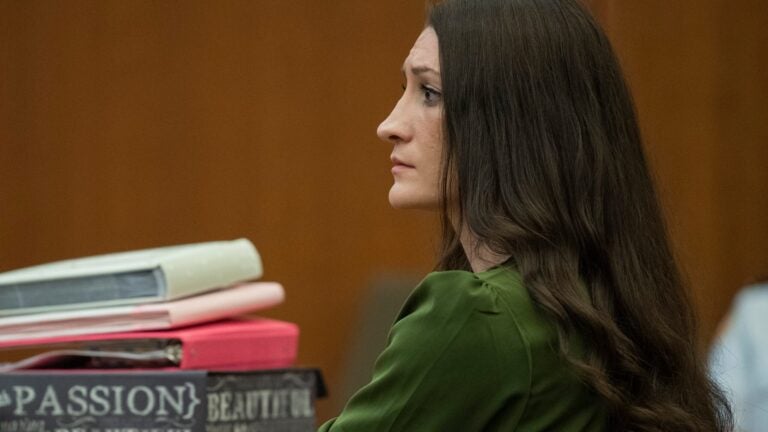
Clancy remains in state custody at Tewksbury Hospital, where Reddington said in an NBC News interview released Sept. 9 that she is suicidal and under a 24/7, one-on-one suicide watch: “She has incredible family support. But she is suicidal… I worry about her every day.” On Sept. 10, Reddington asked Judge Sullivan to declare her not guilty by reason of insanity, arguing prosecutors never proved she knew the killings were wrong; his motion said 11 of 12 jurors were prepared to find her not criminally responsible but for the holdout, and that “no rational jury could find beyond a reasonable doubt that she had no mental disease or defense when the Commonwealth’s own proof established that she did.” Clancy returned to Plymouth Superior Court on Sept. 29 — her first appearance since the mistrial — for a hearing on defense motions that could decide whether she faces a second trial; prosecutors had not said by the morning of the hearing whether Cruz would retry her. The defense’s filings include a motion to dismiss the case on double-jeopardy grounds, arguing Sullivan should have questioned the holdout juror instead of declaring a mistrial: “Where the court receives information indicating that one or more jurors is not fulfilling his duty to apply the law as instructed, the Court has an obligation to inquire,” the motion reads. Boston University law professor emeritus David Rossman called the double-jeopardy motion the most significant because whichever way it is decided, it is the rare pretrial issue a party can appeal immediately. Reddington’s other last-ditch bids include a requested investigation of Desronvil’s conduct before and during the trial — including whether he lied on his juror questionnaire about a prior arrest and received “outside information” on his phone during deliberations — and a push to downgrade the charges to second-degree murder, which would let Clancy opt for a shorter bench trial before a judge; Reddington has said in interviews he would consider a deal as long as it involves no prison time, telling outlets Clancy needs medical and psychiatric help rather than prison. If the DA does pursue a retrial, a new trial date could be set at the hearing. The identification of the holdout as Desronvil and his attorney’s televised defense of the verdict-split kept the case in the headlines in the days before the hearing.
The hearing produced no immediate resolution of the case itself: prosecutors have not yet said whether they will retry Clancy, downgrade the charges, drop them, or seek a plea deal. On October 1, 2026, Sullivan took up the required-finding motion and denied it in a five-page written order, finding the trial evidence sufficient for a rational juror to conclude Clancy was criminally responsible and keeping a second trial on the table; CNN’s case timeline reported that Cruz is expected to decide “shortly.” The trial record also includes new detail on Clancy’s mental-health history: before the killings she saw a psychiatrist, called a suicide hotline twice, consulted two perinatal clinics, spent nearly five days in a psychiatric admission, and was prescribed 13 psychiatric drugs that Reddington claimed worsened her declining mental state.
Reddington’s remaining avenues are narrow: the double-jeopardy motion to dismiss is still pending, he has separately asked the court to investigate Desronvil’s conduct during deliberations, and the request to downgrade the charges to second-degree murder — which would open the door to a bench trial — remains before the court.
A GoFundMe for Clancy’s parents, Michael and Paula Musgrove, passed $1.1 million within a day of the hung jury toward a $3 million target; a GoFundMe spokesperson confirmed the page is “verified.”
The holdout juror himself became a running story: reports surfaced of alleged past domestic violence, an active restraining order against him, and an open eviction case over unpaid rent, while he simultaneously drew an outpouring of support and donations — a split that kept the mistrial’s aftermath in the headlines.
Impact on Their Career/Life
Before her arrest, Clancy was a nurse and a mother of three in a quiet South Shore suburb; afterward, her name became shorthand for one of the darkest chapters in Massachusetts legal history and for the national conversation about postpartum psychosis. Her medical career is long gone — she has been in state custody since her arrest, partly paralyzed from her suicide attempt, and the verdict-less end leaves her in limbo. The question the five-week trial was meant to answer — whether she belongs in prison or a hospital — goes unanswered, with a second trial hanging over her.
Sources
- *NY Post, “Lindsay Clancy murder trial officially ends in mistrial after lawyer’s Hail Mary appeal denied”, 4 September 2026 — source
- *The Guardian, “Judge declares mistrial in Lindsay Clancy case after jury deadlocked again”, 4 September 2026 — source
- *NPR, “With jury deadlocked, judge declares a mistrial in Lindsay Clancy’s murder case”, 4 September 2026 — source
- *ABC News, “Lindsay Clancy trial declared a mistrial. What happens next?”, 5 September 2026 — source
- *NY Post, “Lindsay Clancy supporters flood GoFundMe after mistrial declared — as fundraiser goal goes even higher”, 5 September 2026 — source
- *The Guardian, “Lindsay Clancy’s lawyer asks judge to find her not guilty after mistrial”, 10 September 2026 — source
- *NY Post, “Lindsay Clancy’s lawyer insists killer mom’s defense won’t inspire copycats after eerily similar recent cases”, 10 September 2026 — source
- *OK! Magazine, “Lindsay Clancy Is on ‘24/7 Suicide Watch’ But Has ‘Incredible Family Support,’ Her Lawyer Reveals”, 10 September 2026 — source
- *Fox News, “Lindsay Clancy mistrial declared after jury deadlocks in murder case”, 4 September 2026 — source
- *Fox News, “Attorney for lone holdout juror in Lindsay Clancy mistrial pushes back on claims of refusing the law”, 28 September 2026 — source
- *NY Post, “Attorney for lone holdout juror in Lindsay Clancy mistrial pushes back on claims of refusing the law”, 28 September 2026 — source
- *NY Post, “Lindsay Clancy holdout juror asks for public’s focus to be returned to ‘3 angels’”, 28 September 2026 — source
- *NY Post, “Pivotal Lindsay Clancy hearing could decide fate of her triple murder case after mistrial”, 29 September 2026 — source
- *WBUR, “What to know as Lindsay Clancy returns to court for first time since mistrial declared”, 29 September 2026 — source
- *NY Post, “Lindsay Clancy’s lawyer sets record straight after shock evidence claims at hearing”, 1 October 2026 — source
- *CBS News Boston, “Judge denies Lindsay Clancy’s long-shot bid for a not-guilty finding”, 1 October 2026 — source
- *CNN, “Lindsay Clancy case: A timeline of the Duxbury mom’s triple murder case”, 4 October 2026 — source