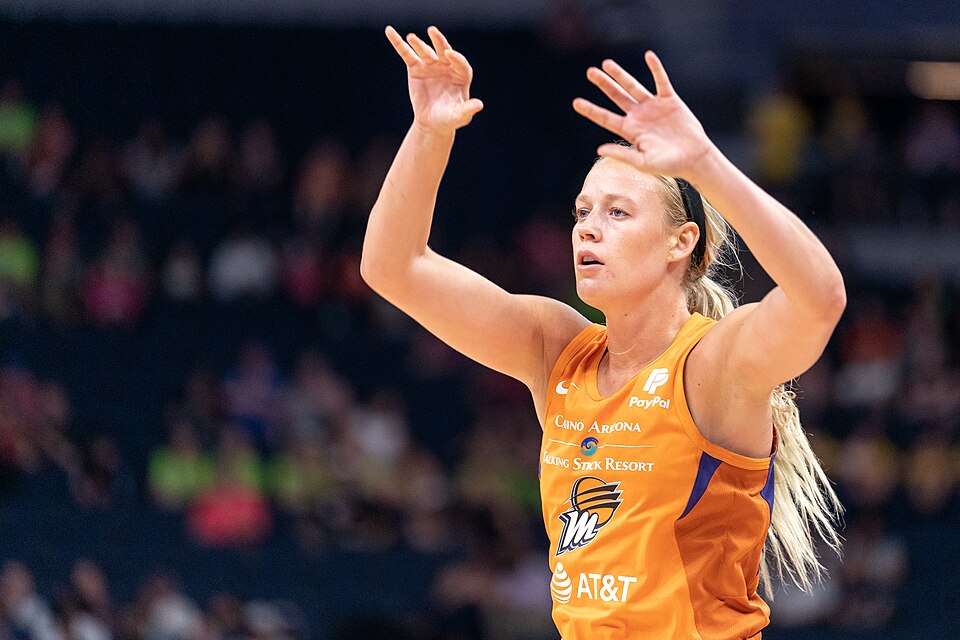
Sophie Cunningham
Introduction
Sophie Cunningham, a guard for the Indiana Fever in the WNBA, became the center of a national controversy in July and August 2026 after an ESPN profile published on July 21 quoted her on transgender athlete participation in women’s sports. Her comments drew praise from conservative figures, including Vice President JD Vance, while rallies for and against her were held before Fever games and she was booed by opposing crowds.
Background Information
Born August 16, 1996, in Columbia, Missouri, Cunningham is the daughter of Jim and Paula Cunningham, both former University of Missouri student-athletes. At Rock Bridge High School she starred in basketball and volleyball and led her team to four straight state titles.
At Missouri, Cunningham became the program’s all-time leading scorer, averaging 17.0 points, 5.4 rebounds, and 3.0 assists over 129 career starts; she was a three-time first-team All-SEC selection and a third-team All-American as a senior in 2019. She was selected 13th overall by the Phoenix Mercury in the 2019 WNBA Draft and spent six seasons with the team, reaching the WNBA Finals in 2021.
On January 31, 2025, Cunningham was traded to the Indiana Fever in a four-team trade. She became known as the Fever’s “enforcer” for Caitlin Clark after being ejected for a Flagrant 2 foul on Jacy Sheldon in retribution for Sheldon poking Clark in the eye. She tore her right MCL in August 2025 and missed the rest of that season, then re-signed with the Fever on April 12, 2026. Off the court, Cunningham is a Christian who has said her faith “keeps me grounded” and describes her politics as “very much in the middle.”
The Controversy or Incident That Led to Their Cancellation
In the July 21 ESPN profile, Cunningham addressed criticism she had received over her views. “I got a lot of negative feedback about me hating trans. And I’m like, ‘I never once said that,’” she said in the feature. “I think that I am here to extend love. But I also think with that love is truth, being honest. And I want to protect young girls in a locker room, or young girls in sport who shouldn’t have to go against biological men.” Wikipedia reports she later reiterated the view, calling it “common sense.”
Since the initial comments, “everyone from her podcast co-host to the White House has weighed in,” according to Yahoo Sports, which reported rallies in support of Cunningham outside arenas where the Fever was set to play. Wikipedia records her statements were widely praised by conservative figures and commentators, including Vance and press secretary Karoline Leavitt, and demonstrations both supporting and criticizing her were held before several Fever games.
Public Reaction and Consequences
The Guardian reported that supporters rallied outside the Fever’s games for a second straight night on August 1, before the Portland Fire game, after a similar rally earlier that week at the Seattle Storm; each rally drew only about two dozen participants. The Seattle rally promoted ballot initiative IL26-638, which would bar transgender students from girls’ athletics at Washington schools, and praised Cunningham’s recent interviews voicing support for barring transgender athletes from girls’ and women’s sports.
In Seattle, two Cunningham supporters sat courtside holding signs. Storm co-owner Celeste Keaton was later fined an undisclosed amount and suspended five games by the WNBA for an exchange with the two supporters; the Storm apologized without details, saying, “We remain committed to creating a welcoming and respectful environment for anyone who attends a Storm game.”
At Portland’s Moda Center, Cunningham was booed when she entered the game midway through the first quarter, many fans waving small pink, blue, and white transgender flags. The Fever still won 112-98 for a fifth straight victory, with Cunningham scoring 13 points.
Cunningham said she was unconcerned that the rallies were a distraction. “I think at the end of the day, I come in and I do my job,” she said. “I’m here to play basketball, but I’m also here to be me, and I’m not gonna like shadow that or hide or, you know, dim my light just because maybe people don’t agree with that.” She added that she had “honestly had nothing to do with” the rallies, calling them people “practicing their rights of freedom of speech.”
Fever coach Stephanie White said she was concerned the controversy was distracting from the team’s play. “You know there is a frustration, of course, because we want to … talk about basketball and we want to continue to work on our game and we want to continue to grow as a team,” she said, while acknowledging the debate was “part of our growth as a league.”
Cunningham doubled down in the days that followed. On August 5, she called for the focus to return to basketball: “I think the WNBA media, all we ever do is cover everything except basketball.” She said it made her sad that the league’s best basketball was being overshadowed: “And it just makes me sad that all this kind of drama … on things that truly don’t matter are getting overshadowed, that the basketball is getting overshadowed.”
Current Status
As of early August 2026, Cunningham remained an active member of the Fever, which was riding a five-game winning streak. Another rally was planned for August 2 in Minneapolis, where the Fever faced the Minnesota Lynx; Yahoo Sports observed she was “trying to pivot the focus away from the controversy she started. Only time will tell how it goes.”
Impact on Their Career/Life
For Cunningham, the controversy thrust a veteran role player into the center of a national political debate. Previously best known nationally as Caitlin Clark’s “enforcer,” she became a figure lauded by the White House and protested at arenas, with support rallies organized around her games and opposing crowds waving transgender flags when she entered the court.
While she insisted the attention did not distract her — “that doesn’t even cross my mind. Doesn’t cross my teammates’ minds” — her coach publicly acknowledged the distraction, and the episode illustrated how a single interview can turn an athlete’s season into a flashpoint in a wider cultural debate. Whether it will affect her standing with the Fever remains to be seen; she continued to play through the furor, including in the Fever’s fifth straight win at Portland on August 1.