Geovany Andres Rojas
Introduction
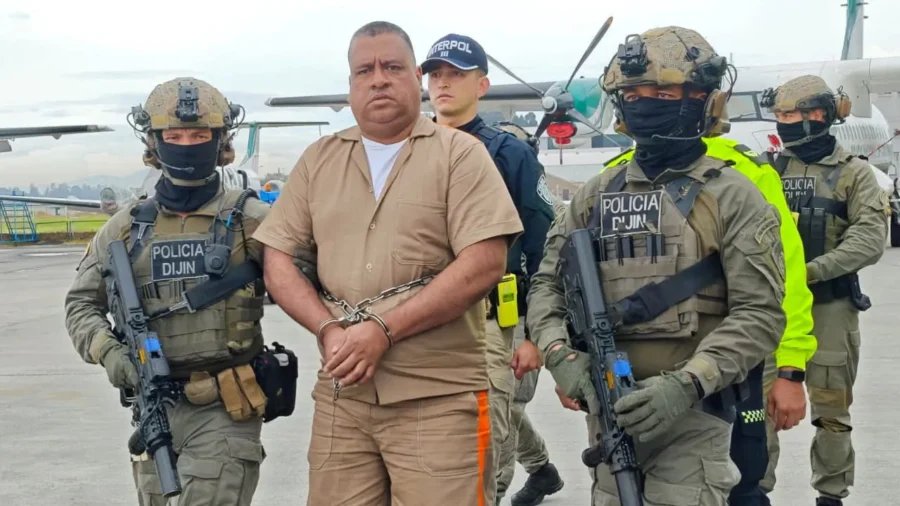
Geovany Andres Rojas is a 45-year-old Colombian national, known by the alias “Spider” — “Araña” in Spanish — whom US authorities describe as the alleged leader of Comandos de la Frontera, a heavily armed paramilitary organization estimated at roughly 1,000 members operating in southwestern Colombia. On September 26, 2026, he was extradited from Colombia and placed in US custody, arriving at an undisclosed location in San Diego surrounded by DEA and FBI agents, to face federal charges of international conspiracy to distribute cocaine and narcoterrorism. The cocaine-conspiracy count carries a mandatory minimum of 10 years and up to life in prison; the narco-terrorism charge carries at least 20 years and up to life. He is expected to appear before US Magistrate Judge Steve B. Chu on September 28, 2026.
His transfer was the first extradition of a senior commander from an illegal armed group under Colombia’s new president, Abelardo de la Espriella, who attended the handoff at a Colombian National Police air base in Bogotá and declared on social media that “Colombia will not be a refuge for drug traffickers wanted by international justice.”
Background Information
Rojas’s path into armed-group leadership runs through Colombia’s longest conflict. He was once a fighter with the Revolutionary Armed Forces of Colombia (FARC), the guerrilla army that signed a landmark peace accord with the Colombian government in 2016, and prosecutors allege he was a FARC member when that agreement was signed — before rejecting it, returning to armed activity, and becoming a guerrilla leader. The group he now allegedly heads, Comandos de la Frontera (“Border Commands”), emerged from the gaps left by the 2016 demobilization: around 2017, guerrillas who refused to disarm joined forces tied to former right-wing paramilitaries, and the organization took its current name in 2020, with Rojas taking over after its early leaders were killed or captured.
Its core territory, according to the US case and regional reporting, is lower Putumayo, a jungle province along the San Miguel river that forms Colombia’s border with Ecuador — one of the country’s principal cocaine-producing regions. US prosecutors allege that under Rojas’s command the group “profited from the cultivation and production of cocaine in southwestern Colombia, maintaining control of its territory using weapons and violence,” and that his cocaine “fueled the Mexican cartels pumping poison into our communities,” in the words of US Attorney Adam Gordon. Rojas allegedly flaunted his power on social media, posing with weapons and heavily armed fighters.
The Controversy or Incident That Led to Their Cancellation
Allegations. The claims in this section are allegations from US federal prosecutors, the US Attorney’s Office for the Southern District of California, and Colombian prosecutors, as reported by the New York Post, NBC 7 San Diego, Reuters and The Rio Times, which reported substantiating them. They have not been admitted by Rojas and have not been adjudicated in court; he is presumed innocent unless and until convicted.
According to the US case file as summarized by Colombia’s Supreme Court, Rojas ran the group from January 2017 to February 2025 and coordinated cocaine shipments toward Mexico and the United States; the evidence cited in reporting includes a load of about 1,500 kilograms of cocaine seized by Mexico’s navy in March 2024. DEA Administrator Terry Cole said Rojas allegedly orchestrated “multi-ton cocaine shipments bound for the United States.” US prosecutors accuse him of drug trafficking and criminal conspiracy tied to alleged operations in Colombia and Ecuador dating back to 2017.
The narco-terrorism count rests, in reporting on the indictment, on the group’s past alliance with Segunda Marquetalia, a FARC splinter that Washington lists as a terrorist organization — drug trafficking that helps fund a designated terrorist group. Separately, Colombian prosecutors this month also charged Rojas over 13 armed attacks in Caquetá that they say killed 16 people between 2020 and 2024; Rojas rejected those charges, and a Colombian judge ordered him held in prison — that case continues in Colombia regardless of the US proceedings.
Public Reaction and Consequences
The concrete consequence is the extradition itself and the federal charges that follow it. Rojas was arrested in Colombia in February 2025 — at a Bogotá hotel, on an Interpol warrant tied to narcotics offenses, issued at Washington’s request — while taking part in peace talks under then-President Gustavo Petro’s “total peace” policy. His extradition was approved but then suspended for as long as he made “verifiable contributions” to peace; Petro’s own peace commissioner had publicly called the arrest a “trap” set for the peace process. The reversal came under de la Espriella, who took office in August 2026, found no verifiable peace contribution from Rojas and four other former negotiators, lifted the suspensions on August 26, and said “spaces for dialogue and false peace are not judicial refuges.” Colombia’s presidency said he had signed 94 extraditions to date.
Coverage framed the handoff as a show of force: a heavily guarded transfer at the Bogotá police air base with the Colombian president attending, then the arrival in San Diego flanked by DEA and FBI agents. US Attorney Adam Gordon said, “Colombia and the Department of Justice are making a clean sweep of narcoterrorists, starting with Rojas.” Wire-based coverage emphasized that the extradition signals Colombia’s pivot away from negotiated peace toward extradition as a signature tool.
Current Status
Rojas is in US custody in San Diego as of late September 2026, facing charges of international conspiracy to distribute cocaine and narcoterrorism in the US District Court for the Southern District of California, with an initial appearance expected at 2 p.m. on September 28, 2026, before US Magistrate Judge Steve B. Chu. A federal grand jury in San Diego returned an indictment charging him shortly after his February 2025 arrest pursuant to an Interpol Red Notice, according to the US Attorney’s Office. All charges remain pending; nothing in the available reporting indicates any conviction, and the accusations are unproven until adjudicated. The Colombian prosecution over the Caquetá attacks continues in parallel.
Impact on Their Career/Life
The extradition ends Rojas’s run as both an alleged cocaine-trafficking leader and, extraordinarily, a recognized peace-process negotiator: Petro’s government had formally recognized him as a negotiator for his armed group in February 2024, a status that let him participate in talks on reducing violence and replacing coca crops — a status now meaningless with his transfer to a US courtroom. If convicted on the narco-terrorism count alone, the 20-years-to-life exposure means the 45-year-old would spend the remainder of his life in US custody. Politically, his case became the emblem of Colombia’s policy reversal — the first senior-commander extradition under de la Espriella, with four other former negotiators’ extraditions unfrozen alongside his.
Sources
- New York Post, “Accused Colombian drug kingpin extradited to California to face drug charges,” September 26, 2026
- NBC 7 San Diego, “Colombian paramilitary group leader extradited to San Diego,” September 26, 2026
- Yahoo News (FOX 5/KUSI, Nexstar), “High-level cocaine trafficker ‘Spider’ extradited from Colombia to San Diego,” September 26, 2026
- NTD (Reuters), “Colombia Extradites Top Rebel Commander to US in First Under New President,” September 25, 2026
- The Rio Times, “Colombia Begins Extraditing Comandos de la Frontera Boss,” September 25, 2026