Bob Vylan
Introduction
Bob Vylan is a British punk-rap duo from Ipswich, England, fronted by Bobby Vylan — a stage name for the performer widely reported to be Pascal Robinson-Foster — with drummer Bobbie Vylan as the other half of the group. Until the final week of June 2025 they were, as the Guardian put it, largely unknown by mainstream audiences, despite having a UK top-20 album and an album-of-the-year award from British rock magazine Kerrang!. That changed on June 28, 2025, when Bobby Vylan led a Glastonbury Festival crowd in chants of “death, death to the IDF” during a set broadcast live on the BBC. Within days the duo had been condemned by the festival and the prime minister, dropped by their US talent agency, stripped of their US visas by the State Department and placed under criminal investigation by police.
Background Information
The duo released their debut album in 2020 and have since put out four albums, each more successful than the last, making politically charged music that combines punk, grime, reggae and indie. Earlier in 2025 they appeared at Coachella for the first time, a sign of their increasing global popularity, and their Glastonbury booking was meant to be a crowning moment of that rise.
Robinson-Foster began his artistic career as a teenager, performing as a poet and grime artist sometimes called Nee-Hi, and mentored young people in Ipswich before forming Bob Vylan after meeting his bandmate in a London bar in 2017. The pair have long spoken out on racism and police brutality in the UK, telling NME in 2020: “We have not been quiet about this, we have been screaming about this.” The movement for Palestinian freedom has been central to their project; Robinson-Foster attended his first pro-Palestine protest at the age of 15.
The Controversy or Incident That Led to Their Cancellation
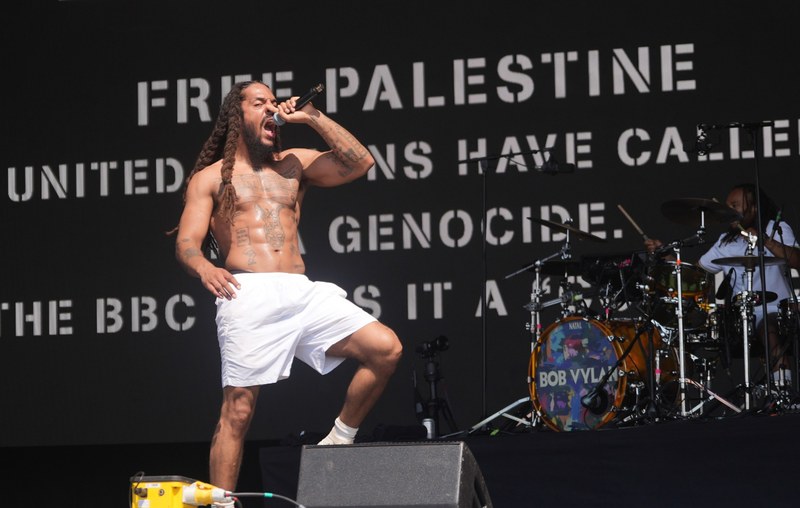
During their June 28 set on Glastonbury’s West Holts stage, ahead of Kneecap’s performance, political slogans were projected onto the screen behind the duo, including “Free Palestine – United Nations have called it a genocide – the BBC calls it a ‘conflict’”. After the crowd began chanting “free, free Palestine”, Bobby Vylan said, “Have you heard this one?”, before leading the chant of “death, death to the IDF”. At another point in the set he told the crowd: “Sometimes we have to get our message across with violence, because that’s the only language some people speak, unfortunately.” The incident sparked particular outrage because the chant was interpreted as a call for the death of Israeli soldiers.
The condemnation was immediate and came from across British public life. Festival organizer Emily Eavis wrote that she was “appalled” and that the chants “very much crossed a line”, saying there was no place at Glastonbury for “antisemitism, hate speech, or incitement to violence”. The BBC said it “regrets” not pulling the livestream and that the “antisemitic sentiments expressed by Bob Vylan were utterly unacceptable”, while Prime Minister Keir Starmer called the chant “appalling” and said groups “making threats or inciting violence” should not be given a platform. Ofcom said it was treating the broadcast as a matter of urgency, and the UK’s chief rabbi, Ephraim Mirvis, condemned the BBC for streaming the performance unedited.
Public Reaction and Consequences
The consequences arrived within two days. On June 30, US Deputy Secretary of State Christopher Landau announced on X: “The @StateDept has revoked the US visas for the members of the Bob Vylan band in light of their hateful tirade at Glastonbury, including leading the crowd in death chants. Foreigners who glorify violence and hatred are not welcome visitors to our country.” The Guardian noted the move appeared to be the first time the US State Department had publicly announced it was banning a musical act because of political statements. The same day, a source confirmed to The Hollywood Reporter that the duo had been dropped by their talent agency, United Talent Agency, and were no longer listed on its roster; NME, citing the Standard, also reported the duo had lost their agent.
Police action followed. Avon and Somerset Police, which organizes policing for Glastonbury, confirmed that “a criminal investigation is now being undertaken”, saying the matter had been “recorded as a public order incident at this time while our enquiries are at an early stage” and that the investigation “will be evidence-led”, considering “all appropriate legislation, including relating to hate crimes”. Some in the music world called the backlash disproportionate: Australian punk group Amyl and the Sniffers, who also played the festival, said Bob Vylan and Kneecap were being unfairly singled out when pro-Palestinian sentiment was the central theme of the 250,000-strong event.
Current Status
The duo’s US visas were revoked months before they were due to begin a 16-date North American tour in Spokane, Washington, in October 2025; The Hollywood Reporter reported it was unclear what would happen with those shows and that they would most likely be canceled if the visa issue still stood. Bobby Vylan defended the chant, writing “I said what I said” in an Instagram post the day after the set, and later clarified that he was not “for the death of Jews, Arabs or any other race or group of people” but “for the dismantling of a violent military machine”. The police criminal investigation remained at an early stage, with no charges announced.
Impact on Their Career/Life
The chant turned a politically outspoken underground act into a global news story almost overnight, and not in the way its members might have hoped: the agent was gone, the US visas were gone and the North American tour was in doubt, while UK police considered whether the words shouted on the West Holts stage amounted to a criminal offense. Robinson-Foster framed the fallout as distraction rather than defeat, writing: “We, like those in the spotlight before us, are not the story. We are a distraction from the story. And whatever sanctions we receive will be a distraction.” The episode made the duo the reference point in a wider argument about where criticism of the Israeli military campaign in Gaza ends and incitement begins — and cost them, at a stroke, the means to bring their music to American audiences.