Sam Douglass
Introduction
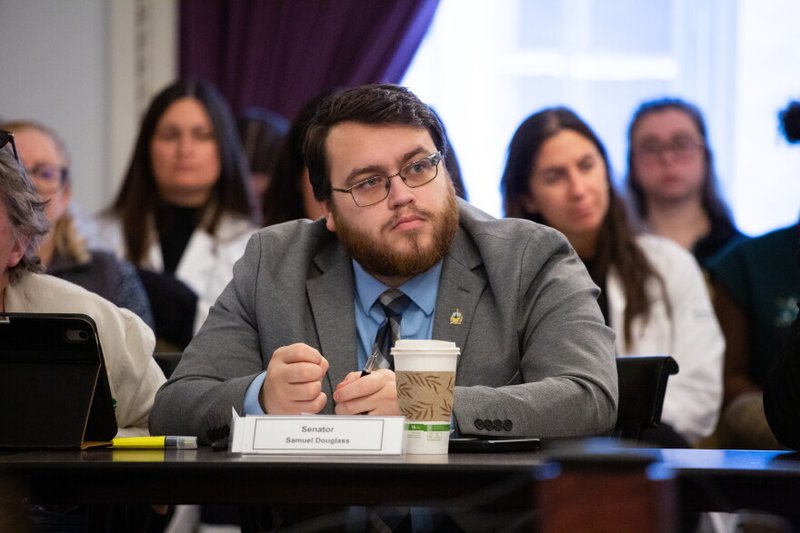
Samuel A. Douglass is an American politician from Vermont who was elected in 2024 to represent the Orleans district in the Vermont Senate. He became the subject of a bipartisan political firestorm in October 2025 when Politico reported that he and his wife had made racist and antisemitic comments in a leaked group chat with fellow Young Republicans leaders, messages that also expressed support for Nazism and white supremacy. Members of both parties in Vermont called for him to resign, and he announced his resignation on October 17, 2025.
Background Information
Samuel Adam Douglass was born in Newport, Vermont, in 1998 and raised in Jay and North Troy. He graduated from Vermont State University’s Johnson campus with a bachelor’s degree in history in 2021 and worked as a farmer and real estate agent. His wife Brianna served as a national committee member of the Vermont Young Republicans. Douglass won a seat in the Vermont Senate in 2024, succeeding longtime incumbent Robert A. Starr, and served from January 2025. He was, according to the reporting, the only sitting elected official in the group chat at the center of the scandal.
The Controversy or Incident That Led to Their Cancellation
On October 14, 2025, Politico reported on racist and antisemitic statements made by Douglass and his wife in a text-message group chat with prominent members of Young Republicans groups in New York, Vermont, Arizona, and Kansas. The chat contained messages praising Nazis, rape, and white supremacy and discussing alleged efforts to suppress documents related to Jeffrey Epstein’s sex crimes. In response to a member questioning whether a woman was Indian, Douglass wrote a remark that was quoted in the reporting as expressing little credit to “the Jew to be honest.” Vermont Republicans and Democrats condemned what Governor Phil Scott called “vile, racist, bigoted, and antisemitic” dialogue, and Scott called for Douglass to resign and to leave the Republican Party.
The fallout moved quickly. On October 15, Douglass was removed from his duties with the Vermont Republican Party, and later that day the party’s executive committee issued a statement calling for his immediate resignation. Douglass did not respond to Politico’s requests for comment about the incident. In his resignation announcement he stated, “Offense was taken and people were hurt, so I will mend bridges to the best of my ability.” His wife Brianna also resigned from her position as the Vermont Young Republicans’ national committee member.
Public Reaction and Consequences
The resignation drew broad attention as an example of the consequences that can follow leaked private social-media and group-chat content for public officials. Both parties in Vermont had called for his departure, and the case was covered nationally, including by The New York Times, The Washington Post, and The Guardian. Douglass’s seat in the Vermont Senate was left in limbo for several days; his resignation was to take effect on October 20, but as of October 21 he had still not officially resigned, and he submitted his formal resignation on October 22. The incident also fed into the wider national debate about the culture of the Young Republican movement and the role of social-media group chats in political accountability.
Current Status
As of the material reviewed, Douglass had formally resigned his Vermont Senate seat, having announced the resignation on October 17 and submitted it on October 22. In his statement he said he had reached out to “the majority of my Jewish and BIPOC friends and colleagues” and reflected on his “duty to set a good example” as a young person. In February 2026, a story on the Vermont Legislature’s school redistricting effort appeared under Douglass’s byline on the Vermont Daily Chronicle, a conservative news website, where he began writing on a per-story basis. His political career in Vermont ended with the resignation.
Impact on Their Career/Life
The episode ended Douglass’s fledgling political career less than a year after he took office. It made him a prominent example of the risks that private group-chat messages pose to public officials, and of the speed at which bipartisan pressure can force a resignation. The case was cited in national coverage of the Young Republicans group-chat scandal and in broader discussions about the boundaries of acceptable political speech online and the accountability of elected officials for their private digital communications.